Sunday, April 4, 2010

Week 1 Internet and Interactive Marketing


Interesting technical topics that expanded my horizons of internet marketing this week included:

1) Flash is not supported by the iPhone or any touch device

2) PHP is used instead of HTML for dynamic websites

3) Drupal can be used to allow anyone to have access to modify your website

4) the more external links you have to your website the more probable that Google’s SEO might find your webpage.

The topic of Flash has also come up in my web development class at Harper College. Flash on a website may limit the number of people who can view your site. If the user has to download an application they might move on to where they can get the information faster.

Interested in learning more, I did a search on what might replace Flash and found The Future of Web Content – HTML5, Flash & Mobile Apps.”

One shift in the technical environment is that the number of mobile device platforms has increased. Flash covers 75% of the market share for online video but has we know the iPhone does not support it. This means that approximately 10M people cannot view flash on their iPhone. Politics, audience bias and not technical issue drive the battle between Apple, Google and Adobe. Each company has their favorites. One of the potential replacements for Flash is HTML5, which seems to align well with Google. HTML5 would allow a common video format.

Functionality of HTML5 and customer reach will depend on the browser you use. As we saw in class, the market share covered by each browser is constantly changing. However, part of the problem with removing Flash is that it is embedded in the infrastructure of many websites. It is like changing from oil to biofuels. It takes time to build a new distribution system. But ultimately it will boil to what the customer wants. The answer, in reality, may not be black and white but shades of gray.

In addition to the lecture portion of the class, I learned from one of my classmates that most companies do not make their website accessible to users with disabilities. It is an unwanted added cost of development. Perhaps this is the difference between academia and the working world. If the market share of customers with disabilities were large enough, I am sure the website would be accessible. The common theme seems to be that technology and marketing must go hand in hand, determining the target customer is important, as it determines what channels you will use to reach them. Investigating customer behavior first may heavily influence the type of technology you use.

Friday, November 13, 2009

Green NPV outweighs Finance NPV: Water Efficient Toilet Replacing Decision


My first finance course has given me to power to make decisions based on facts. During the time of recession that we are in, many of us are doing home upgrades. To convince my husband to upgrade our toilets I've planned to impress him with this NPV calculation (he loves finance). When we make our choices, increasingly we are including green in the picture. What I have learned about finance has given me the synergistic power of quantifying a green decision. In finance you learn about Net Present Value or NPV. NPV gives you the power to make a financial decision based on the future cash flow. If NPV is positive you will make money and you choose the decision. If it is negative you do not pick it. We can apply this financial principle to carbon flow as well. What do I mean by carbon flow? I mean the carbon inflow and outflow required to produce and distribute any product or service.

When you consider any decision you should also consider not only the financial NPV but NPV of carbon flows or the life cycle analysis, LCA flows. Expressed in an equation total NPV = NPVfinancial + NPVcarbon. One example I will give you is, the decision to replace all the toilets in your house with water efficient toilets.
If we look at the LCA flow of the old and new toilets we have:

NPVLCA = benefit for years – cost in the first year

If this is positive we replace the toilet depending on the financial reasons

= increased water efficiency – (energy required to make the ceramic toilet + transportation of toilet)

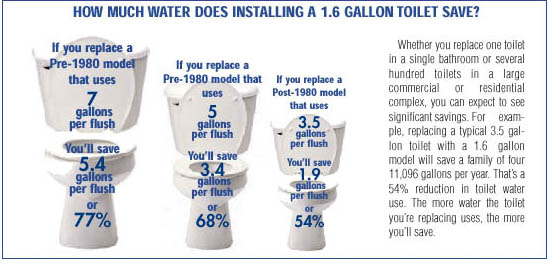
It is assumed that ceramic would be an approximation for cement and that an average toilet weighs 75 pounds. Water savings would be 68%. The average household uses 238 gallons of water per day[6] or 87,000 a year. Savings would be 59,000 gallons of water. How much carbon or energy does it take to make 59,000 gallons? The amount of carbon saved is per 80,000 year. One question I have is what to use for the discount rate and over how many years? We can assume forever. The discount rate would be equal to the rate that carbon emissions are increasing each year, which is currently 2.5%[9], oddly enough approaching about the same rate of inflation.

Because carbon is the universal metric we convert all quantities back to NPVcarbon
NPVLCA = NPVcarbon = carbon factor H20 – carbon factor ceramic + carbon factor transportation

NPV(year 1)= 80,000 tons saved every year - [(1 t C/t cement)(0.034) + 3 ton C/ton gasoline]yr 1

= (80,000/0.025) – 3.034 = 2.4 million tons carbon

2.4 million tons of carbon can be saved by replacing one toilet that is more water efficient over the lifetime of the toilet.

The financial NPV is
NPVfinancial= benefit – cost

= savings on water bill forever– cost to replace toilet

= (25/0.03)-(500) = 833 – 500 = 333

If you saved $25 a year by changing the toilet the benefit outweighs the cost in NPV terms by $333.

Looking at the combined effect of financial and carbon flows, overwhelming the answer to replacing your toilet with a water efficient toilet is a resounding yes for greens all around.

One thing to note about this calculation is how easy the financial NPV is to calculate, but how much more complex a carbon NPV is to determine. Many assumptions and approximations might have to be made. What is powerful about this calculation is that the environmental effect of replacing one toilet has such a huge impact relative to the financial impact.

1. http://www.survivalinsight.com/reduce-water-bill-costs.html
2. http://answers.yahoo.com/question/index?qid=1006032214497
3. http://www.sciencedirect.com/science/article/B873D-4P9MYFN-BK/2/c58323fdf4cbc244856fe80c96447f44
4. http://www.ghgprotocol.org/downloads/calcs/co2-mobile.pdf
5. http://www.crd.bc.ca/water/conservation/household/indoorsavingtips.htm
6. http://www.greenbuildingsupply.com/Public/Energy-WaterConservation/WatersavingToilets/CaromaDualFlushToilet/index.cfm
7. http://www.epa.gov/waterinfrastructure/bettermanagement_energy.html#basicone
8. http://www.epa.gov/watersense/
9. http://www.sciencedaily.com/releases/2006/11/061130190831.htm
10. http://www.greenandsave.com/remodeling/bathrooms/water_efficient_toilets.html

Thursday, November 5, 2009

On Crossing Over From Science to Business

I am half way finished with an MBA at DePaul, and the question of what ares of science/chemistry are most similar to business is becoming clearer. I've all but finished my required courses, and I'm down to the six electives and the one or two concentrations that I've chosen. I've chosen finance as my concentration and most likely entrepreneurship, but I'm still intrigued by marketing.

What makes the decision hard is that I am uncertain what part of my past life as a scientist will lead me to a future in the business world. In the past it has always been technical skills that got me a job and not so much my people connections. The challenge I find is in marketing myself and breaking away from the scientist stereotype - something that I would like to make my strength and not my weakness (people tend to see me as only a scientist). My short term goal is to transition to marketing or operations management in the biotechnology or pharmaceutical industry where I have the most experience.

I've taken accounting, business statistics, organizational behavior, economics, management of information systems, operations management and now finance and marketing. The classes I find more reminiscent of "chemistry skills" are finance, marketing and operations management.

I'll first describe the disciplines of chemistry and then follow up with business and how they are related. In chemistry there are the basic disciplines of general, organic, analytical, physical and inorganic chemistry. Generally, the most jobs in industry go to organic and analytical chemistry. Organic chemistry has to do with the study of chemical reactions of compounds consisting mostly of carbon and hydrogen. If you are a strategic thinker and can apply rules, you'll be good at organic chemistry. It also has a lot to do with geometry and shape. Inorganic chemistry has many parallels as well with organic, but the chemical compounds contain a metal. Analytical and physical chemistry have more to do with analyzing and fitting chemical behavior to models. Quantifying and predicting are important. Building equipment and writing computer code can also come in to play.

Of the business courses I've taken I would divide them in to organizing/categorizing/efficiency, forecasting/predicting, organizing people/communication skills, analyzing/quantifying/research

Functional Skill

Business

Chemistry

organizing/categorizing/efficiency

Accounting, Ops Management

Organic, rxn type, % yield

forecasting/predicting

Economics, Finance

Physical

organizing people/communication

Organizational Behavior, HR

N/A

analyzing/quantifying/research

Finance, Marketing

Analytical, Physical
Research applies to all


A person can over analyze decision making when it comes to careers. What it really boils down to is are you passionate and motivated about the path you've chosen. If you have these elements when you inevitably hit a stumbling block, you can keep going. If we could all forecast the future then that would be boring. For me, I'll be gathering information until the very last minute and then make the best choice possible.

Saturday, May 3, 2008

Calculation of Greenhouse Gas Emissions on the Internet are Not Equivalent


Calculation of Greenhouse Gas Emissions on the Internet are Not Equivalent

By Wanda K. Hartmann

Recently, my husband asked me how greenhouse gases (GHG) emissions are calculated. My husband’s argument is, how accurate are these numbers and what are the approximations and estimations? What can we believe? Plato once said that “Science is nothing but perception.” In the case of measuring GHGs this is probably true. GHGs seem like a back of the envelope calculation, but measuring GHGs are really about measuring human activity. In contrast to plants that rely on photosynthesis and taking CO2 and turning it in to O2, we humans rely on respiration; our activity is based on producing CO2 and related gases from byproducts.

As a chemist, my first guess on measuring GHGs is that they are calculated from the amount of energy and fuel that is used by a person or a company. When you consider that companies and individuals invest money in carbon offsets, a highly accountable system of checks and balances should be in place, as well as a system and method of standards. The Nature Conservancy is one company that offers a plan where carbon offsets can be purchased.


I set out to answer this question and found the EPA, Nature Conservancy and AOL sites

The EPA site considers mainly fuel and energy for calculating GHGs. However, the Nature Conservancy site also includes things such as air travel, composting waste and diet. A meat eater’s diet contributes 3.6 tons of CO2/yr vs. vegetarianism at -6.4 tons of CO2/yr. Eating organic and composing unused food can help a bit. 20% of GHG production according to the Nature Conservancy is from food and eating (12 tons). The sum total of my house hold activity on the Nature Conservancy site was 43 tons compared to 20 tons (40089 pounds) on the EPA site. If you subtract out food the Nature Conservancy value is still 31 tons compared to the EPA. There is another 10 tons of difference to be accounted for. In looking at the individual numbers, the Natural Conservancy differs from EPA by twofold larger numbers on waste and recycling, 10 times larger estimates on home energy (heat and electricity) and is 40% less on the estimate for the car emissions.

Table 1. Household emissions for two people


EPA Pounds of CO2/yr

Nature Conservancy

AOL

Household emissions

Pounds

Pounds (tons)

Pounds

Car

13519

5403(2.7)

15145

Natural Gas – heat

6802

64000(32)

8469

Electricity

18577


20573

Waste

2036

4800(2.4)


Recycling

-875

-2000 (-1)

-940

Composting


-400 (-0.2)


Air Travel (4 short flights)


2800(1.4)


Food


16200(8.1)


Eating Meat


7200(3.6)


Total

40089

86-98000

40282

When it comes to recycling EPA gives a 845 pound CO2 credit for recycling. The Nature Conservancy gives -1 ton or -2000 of CO2. The credit given to by the Nature Conservancy is double.

EPA Results

What I found from fueleconomy.com is that my Honda Accord 1997 puts out about 7.1 tons of CO2 in a year. My husband’s Passat emits 8.0 tons of CO2 in a year. For comparison the 2008 Prius puts out about 4.0 tons of CO2 a year. Our home energy bill breaks down into heat and gas. GHG are estimated from the average monthly bills. The final aspect is waste. Recycling can offset GHG emissions by as much as 50% if you recycle. Our total emissions are 40,089 pounds of carbon a year (1 ton = 2000 pounds,) which is close to the average amount.

We can improve on emission most by buying an energy efficient water heater and replacing the windows in our house. If we do this we will save nearly 15-20% of our household emissions. The most interesting fact I found is that most of our GHG emissions come from using electricity by the EPA calcuations. If we had photovoltaic solar panels we might be able to improve upon that. In addition we could buy a car with better gas mileage and save another 4 tones of CO2 a year or 8000 pounds a year.

Summary

When it comes to estimating automobile emissions EPA seems to be the most accurate as it considers the year of the vehicle. Of the three GHG online calculations EPA and AOL are in close agreement but still off by about 2000 pounds from each other. The Nature Conservancy numbers seem to be way off from the EPA and AOL numbers (conversion 1 ton = 2000 pounds). The home energy number of 32 tons or 64,000 from the Nature Conservancy seems to be far off from the other EPA and AOL numbers, although the Nature Conservancy brings up a good point with food and eating meat as a part of the GHG gas equation. If I considered buying carbon offsets I would serious reconsider after looking at these numbers. Some numbers are way off. The EPA bases the emissions on monthly energy bills. The Nature Conservancy bases these numbers data from geographical regions, which in my opinion may have more error. The next part in this series will discuss corporation based GHG calculations.